Ar y Bysiau (Welsh: on the buses)

I’m someone who can drive but doesn’t currently have a car. I rely on public transport and good old walking wherever I go. When I go on hiking trips to the Lake District or my homeland, North Wales, I use the public buses to get everywhere. If you’re a car owner you’re probably recoiling in horror right now, but let me tell you about the joy of bysiau.

Travelling on foot or by bus means that you are forced to really look around where you’re based, to see how it’s connected with everything around it, where the little paths and streams are, the small bridges and stepping stones that connect fields, the backroads to the path up the local hill. If you have a car you spend your time leaving the place you’re in to find something better on the map. You’ll never see those tiny streams and paths or notice that the old railway line has been turned into a leafy walk to the next village.

I have just spent a few days in a North Welsh hamlet with only two bysiau a day, but with the Lôn Las Ogwen railway track footpath on its doorstep. Everyone in the accommodation around me was offering me lifts to towns and attractions around us, but not one of them climbed the local hill, walked through the local forest or used the Lôn Las Ogwen to get to the next village. They never found the Blas Lôn Las farm cafe and shop en route, or the path that links it to the local Moelyci mountain in the Carneddau.

They never worked out that they could catch a bus from the next town (Tregarth) to the Ogwen Valley, where a volunteer-run bus (Bws Ogwen) would carry them to the start of all the great mountain hikes in the Glyderau and Carneddau. They didn’t chat to the two drivers who run it because they were the only ones on board and found out where the best pub was in Bethesda. They never found the Pant-yr-Ardd pub in Tregarth which is hosting a rodeo tonight (so sad not to be there) or met any of the funny, welcoming, wry locals who would tell them why the local shop closed or why they were struggling to get on the property ladder.

Now on the island of Anglesey, or Ynys Môn in Welsh, I’m restricted to bysiau but there is one bus, the 62, that stops everywhere along the east coast so you can make up your own hikes between stretches of the coast path. I make the most of my waiting time for the 62 by going for coffee or ice-cream at Amlwch harbour or Moelfre village, chatting to people at the table or bench next to me because that’s what people do here.

This trip has reminded me of the girl I was in my teens, sometimes with my mum but mostly alone, travelling by bus around my homeland, chatting to people and knowing the tracks and trails of the land like the back of my hand because I’ve walked them over and over again. Being so-called ‘restricted’ by bysiau means I return again and again to well-worn paths, like the one I’ve just done between Amlwch and Point Lynas. I like finding the small landmarks again – the tiny bridges over streams, the sea-wall paths around bays – and walking them again and again until I’m part of them. Once again, I was the only one on the bus, and the driver said, in that wave-like North Welsh accent I know so well, “You might struggle to find a seat…” as I boarded. He drove into village after village, having to turn around and come back on himself in each one, because that’s what the service does – drives into a village and out again like a bee finding nectar in a row of flowers.

I have come full circle to my teenage self, walking the land alone and relying on bysiau to get around. Wales is full of girls like I was – I can see them now, out with their mums and grandmothers, hoping for something dramatic to happen, not realising that their solo roaming on the coast path will come to define who they are in the future. Their hair blows in the wind and their pale, freckled faces turn to the sun as they wait at the bus stop, watchful and expectant.

It’ll come, girls, it’ll come.

Beyond Sunset

I’ve been living in South Goa for nearly four months now and yet again, I’m following my old routine of early morning walk on the beach, masala chai, yoga, breakfast then work.

I don’t emerge from my room (or wherever I’m working) until the hottest part of the day is over, which is after 3pm (and usually 4.30pm for me). I’ll then go somewhere on the bike or go for another beach walk before dinner. It’s very similar to my routine in the UK, minus the bike rides.

Two women in the house where I’m renting rooms were shocked to discover that my daily routine doesn’t include swimming in the sea or sunbathing, and it doesn’t even include sunset. They asked me why I come to Goa at all if I don’t do those things.

I am equally shocked that someone might think that Goa is ‘only’ those things. For me, sunrise is the best time of day here – cool enough to walk in layers, quiet on the beach, fishing activities to meditate on, eagles circling overhead, dolphins offshore, incense wafting down the sands, dogs stretching and then trotting over to say hello. At sunset, the beach is noisy and busy, it’s much hotter and humid, mosquitos are starting to come out and the fishermen are long gone. And let’s be honest, Indian sunsets outside monsoon aren’t as dazzling as some I’ve seen in the UK. The hour after sunset is when the magic happens – when the orange-pink glow blushes in the sky.

Despite attempts to force it to be a part of my routine, swimming just isn’t. The waves are hard to swim against here and I find the whole salty hair/sandy body thing a faff. I like doing it now and again when my hair needs washing, but that’s it. I much prefer being on the water in a boat than in it. I don’t like lying in direct sunlight, so sunbathing isn’t for me either – the sun I get is only during my walks or on the back of the Enfield. In a country where pale skin is prized, I’m happy to hang on to mine. I can’t help thinking that a tan is basically just skin damage that fades within weeks, so no, I don’t do that either.

So what do I do in the paradise beach location? Why do I come to South Goa if I am avoiding its so-called main pleasures? Because it’s so much more than that. It’s winding roads through forested ghats, green rice fields bordered with bright saris tied to bamboo poles, villages where puja creates smoky light in the late afternoon, monkeys playing in tamarind trees, blue chai carts next to bridges, temples filled with laughing women, hilltop views over hills and down to the sea, children shouting and waving as they walk home from school. I’d trade a day of this for ‘sun-worshipping’ every day of my existence.

White Horse never leaves me

Anyone who’s read my books will know that horses, especially white ones (and the occasional dark ones) tend to follow me around in life.

On a recent trip back to my homeland, Wales, I returned to Point Lynas on Anglesey, the place where I’d seen the Risso dolphins last year, under a rainbow. It really is a special place, where wildlife appears to gather, possibly due to the accessible feeding ground afforded by the shallow waters beneath it.

I stopped to talk to a couple who’ve been coming here for over 30 years, to sit on a blanket with flasks of tea and watch for wildlife. The sun was shining and the waves sparkling. I could see why they kept coming back. I probably will.

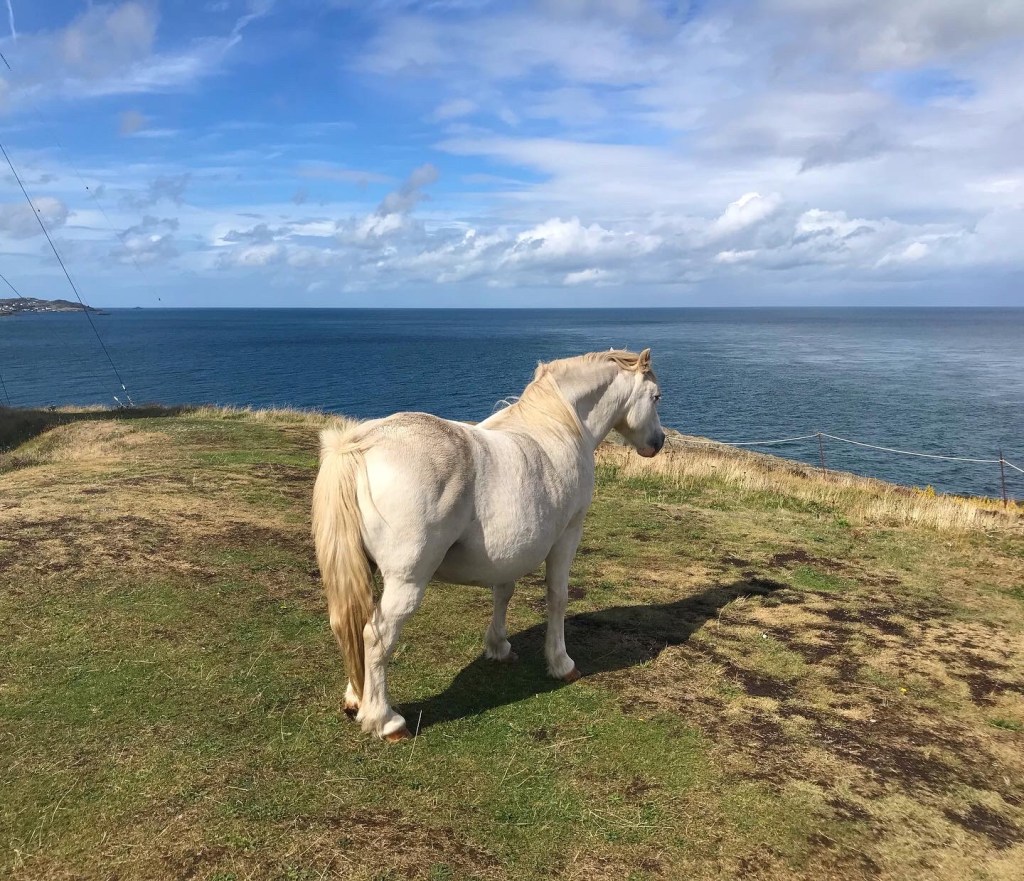
I didn’t see any dolphins that afternoon but as I returned to the path, a white horse greeted me in front of the lighthouse. I laughed because she’s always there – my spirit animal, wild and free, alone yet not alone, looking out to sea with her mane blowing in the wind, feeling her soul come alive.

The Edge of Reason

Whenever I walk the Seven Sisters coast path, I notice a significant number of people who are prepared to stand – or even sit and eat lunch – on overhanging cliff edges on a stretch of coast that is known for its crumbling rock.

I am not one of these people and I would dearly love to know why they are prepared to take a very obvious risk and why I am not.

Do they simply have no fear or does it never cross their minds that a cliff fall would happen to them?

I’m the same with narrow edges and ridges in the mountains – my fear of falling off them is validated time and time again with stories of it happening yet people continue to do it. I would never take a risk that was unnecessary, just for the thrill of it.

Am I missing a risk-taking gene?

Which one are you? A cliff-edger or a far-away-as-possibler?

Misty

White horses appear to be a theme in my life, so when I sat down to eat my lunch during yesterday’s hike, I wasn’t surprised to find one munching some grass right next to me.

Misty’s owner told me that she is 15 (about 45 in human years) and that she was rescued from a bad life in Ireland where she’d been forced to have lots of foals and been in a road accident.

Now she lives a peaceful existence on the South Downs, but is still afraid of fast-moving bikes and cars.

What I didn’t know is that the grass that surges after summer rains is like crack for horses. It’s full of sugar and they go crazy for it, hence the munching. Misty’s owner said they’d ‘work it off’ by having a quick trot after lunch.

After she left, her soulful eyes looking at me sideways under long lashes, I thought about Misty in her midlife prime, having lived a difficult life but finding peace (and sweet grass) on the South Downs and realised we had a lot in common.

If you’ve read Cheat Play Live you’ll know how White Horse in Agonda was my spirit animal, showing me what a free and independent life could be like, by the sea. Misty, although not completely free, reminded me that the next move I make needs to be where the grass is sweet and the humans are kind. I think I know where that is.

The Child Within

Ever since I moved to Worthing just before lockdown in 2020, I’ve been walking by the sea and finding children’s lost shoes – always one, always glittery – placed on benches. I wish I’d photographed every one I’d seen because I’d have quite a collection.

They made me smile during lockdown because they seemed like a symbol of hope for the future and they make me smile now, because so many children love the seaside, as I did back in Wales. The lost shoe is a symbol of a fun day out.

Just because I’m childfree-by-choice doesn’t mean I don’t appreciate children. I love seeing them run towards the sea, giddy with joy. I remember one day during lockdown I heard a small child squeal, “It’s the sea!!” and her mum told me they hadn’t seen it in months. That little moment of #lockdownjoy stayed with me for a long time.

Here’s to the unfettered joy of children, that lies within all of us, waiting to run towards the sea.

The Ultimate Freedom

On today’s hike I saw a young woman carrying her paddleboard out of the sea, barefooted, about to cross the road back to her home. I told her that it looked like she was living the dream, and she said it was only the second time she’d been out on the water. She pointed to a distant structure in the sea and told me she’d got out as far as that and it felt really far away and she got scared, but she made it back. She had that look of wild elation.

She asked me where I was going and I told her about my solo hike. I told her how I loved the freedom to choose where I was going and sometimes I felt scared but it made me feel alive. I told her how good it was to see a solo woman coming out of the sea with her board tucked under her arm, the ultimate freedom.

I’m about to complete my final refresher driving lesson before my road trip in a campervan in September. I know I’ll feel scared, not having driven for over ten years, but I know I’ll feel free and alive. I’ll be announcing more details in my next newsletter (link on page).

Herd community

One of the best things about solo hiking for me is not knowing who I’m going to meet along the way. I often end up chatting to someone, briefly, and there is something special about meeting them on the open road, away from any distractions.

Last weekend I met a woman with a dog called Bonnie (sadly I’d didn’t get a picture of her but I feel awkward asking someone for a pic in the moment).

Bonnie was a sheepdog – a border collie. Normally these dogs are too intent on herding some unseen sheep to pay attention to humans but Bonnie came up and pressed her head against my leg.

I got chatting to her owner who said Bonnie has a gift for seeking out people who need a dog hug. In the woods near where they live, she told me, Bonnie has twice tracked down people who are crying and feeling lost and stayed with them. Perhaps she is using her herding instinct to look for humans who need contact with other beings to feel good about themselves. That certainly applies to me.

I love to walk alone but I love the people and dogs I meet even more.

Order your copy here!

Wholehearted

This past week I have been listening to Brene Brown talking about the Power of Vulnerability. She is a researcher who has found that people who live ‘wholehearted’ happy lives have several things in common, many of which relate back to the yoga lifestyle. Her data shows that these people are spiritual in one way or another, that they believe that we are all connected by something bigger than ourselves. It also shows that wholehearted people engage in creative pursuits and practice gratitude.

Santosha is a 5,000 year old Sanskrit word for ‘contentment’ – being happy with whatever you have. As a yoga practice, it’s being grateful for specific things in your life. On my morning walks I find it improves my emotional state so much if I list these things in my mind. They can be as simple as finding a new path to walk on or having a chat as I buy a coffee.

Today I met Valerie, a lady who told me she’d been evacuated during the war to Shropshire, near the Welsh border. We talked about how much we liked wildflowers and the tamarisk bushes by the sea, even though they’re overgrown. Each person who walked past us said, “Ooh they need to be cut back, don’t they?” but we grinned at each other and said the bushes were lovely, filled with bees on the tiny flowers.

Thank you, Valerie, for reminding me that the obstacles in our path are sometimes worthy of the space they take up in our lives – we can simply walk around them, gazing in awe at the sight, rather than raze them to the ground.

Everything is food

One of the things I’ve been learning on my Indian philosophy course with Sudhir Rishi is the idea that whatever we take in through our senses is ‘food’. Whatever we taste, smell, see, touch or hear feeds not only our physical body but becomes associated with our thoughts and moods, our memories of joy and sadness. You might say, ‘we are what we sense’.

My hike yesterday was filled with the smell of wild garlic, the sight of yellow dandelions, the sound of birdsong and lambs, the taste of lemon drizzle cake and the feel of warm wood under my hands as I passed through gates.

While walking, I thought about how I feed my body and mind, not always with the things that make it happy, whether that’s scrolling on my phone, watching trash TV, eating processed food, drinking alcohol or listening to an argumentative political radio show.

Once you start thinking of all these things as food, it’s easier to cut some of them out. In Indian philosophy, everything in existence is ‘god’ including your own body, so why would you offer it something bad? I’m not saying I’ll be able to change all my bad habits overnight but it’ll make me stop and ask myself some questions before I let them in again.